AI Awareness and Employment Risk among College Students
Keywords:
Artificial Intelligence; AI Awareness; Employment Risk Perception; Employment Anxiety; Learning Goal Orientation; College Students; Career Uncertainty; Moderated Mediation.Abstract
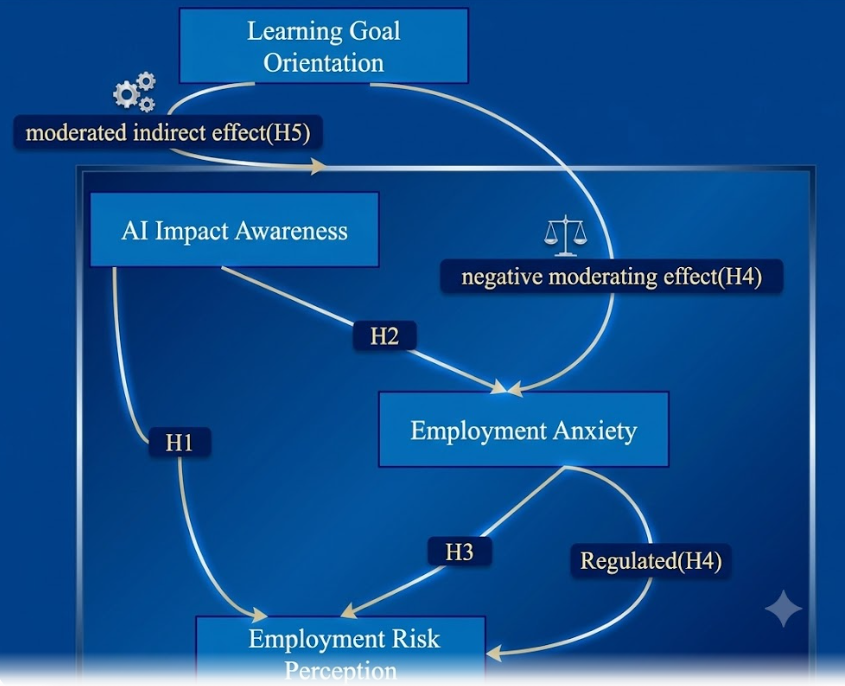
In the context of rapid technological advancement, college students are increasingly concerned about the potential impact of artificial intelligence (AI) on their future employment. This study examines the relationship between awareness of AI’s impact and college students’ perceptions of employment risk. Based on empirical data collected from 1,558 college students, a moderated mediation model was developed to investigate the underlying mechanisms of this relationship. The findings indicate that greater awareness of AI’s impact is positively associated with students’ perceptions of employment risk. Employment anxiety mediates the relationship between AI impact awareness and perceived employment risk, suggesting that increased awareness of AI may increase employment anxiety, which subsequently strengthens students’ perceptions of employment risk. Furthermore, learning goal orientation negatively moderates the relationship between employment anxiety and perceived employment risk. In particular, a stronger learning goal orientation weakens the mediating effect of employment anxiety on the relationship between AI impact awareness and perceived employment risk. These findings provide useful insights for educational institutions, policymakers, and other stakeholders in developing appropriate interventions to address students’ employment concerns related to AI and to support effective AI-related educational and workforce policies.
.
References
[1] Ge XW, Liu X, Wang KY, Li YX. Challenge or threat? Research on the double-edged sword effect of AI awareness on career decision-making difficulties. Curr Psychol. 2025;44:1228–12302.
[2] Ge XW, Liu X, Wang KY, Li YX. Challenge or threat? Research on the double-edged sword effect of AI awareness on career decision-making difficulties. Curr Psychol. 2025;44:1228–12302.
[3] Yam KC, Tang PM, Jackson JC, Su RK, Gray K. The rise of robots increases job insecurity and maladaptive workplace behaviors: Multimethod evidence. J Appl Psychol. 2023;108:850–870.
[4] Lingmont DNJ, Alexiou A. The contingent effect of job automating technology awareness on perceived job insecurity: Exploring the moderating role of organizational culture. Technol Forecast Soc Change. 2020;161:120302. doi:10.1016/j.techfore.2020.120302.
[5] Ito JK, Brotheridge CM. Resources, coping strategies, and emotional exhaustion: A conservation of resources perspective. J Vocat Behav. 2003;63:490–509.
[6] Trumpold K, Zapf D, Kern M. A reverse perspective on emotion work and well-being: Connecting chronic burnout to emotion regulation from an antecedent perspective. Int J Stress Manag. 2024;31:252–265.
[7] Hobfoll SE. Conservation of resources: A new attempt at conceptualizing stress. Am Psychol. 1989;44:513–524.
[8] Lee HH, Yang TT. Employee goal orientation, work unit goal orientation and employee creativity. Creat Innov Manag. 2015;24:659–674.
[9] Bereby-Meyer Y, Kaplan A. Motivational influences on transfer of problem-solving strategies. Contemp Educ Psychol. 2005;30:1–22.
[10] Abbasi, B. N., Wu, Y. Q., & Luo, Z. M. (2025). Exploring the impact of artificial intelligence on curriculum development in global higher education institutions. Education and Information Technologies, 30, 547–581.
[11] Al-Zahrani AM, Alasmari TM. Exploring the impact of artificial intelligence on higher education: The dynamics of ethical, social, and educational implications. Humanit Soc Sci Commun. 2024;11:1–12.
[12] Tzirides AO, Zapata G, Kastaniotis NP, Saini AK, Castro V, Ismael SA, et al. Combining human and artificial intelligence for enhanced AI literacy in higher education. Comput Educ Open. 2024;6:100184.
[13] Ravishankar K, Logasakthi K. Impact of artificial intelligence on students’ sustainable education and career development using extended TOE framework. Korea Rev Int Stud. 2023;16:22–35.
[14] Jeremie M, Maimaiti G, Ru N. Examining international graduate students’ career willingness in China: Influencing factors and integration of professional development. J Stud Int Educ. 2024;28:835–856.
[15] Fang H, Xu XY. The role of psychological resilience and career adaptability in the relationship between perceived social support and employment anxiety among college students. J Psychol Afr. 2025;35:151–157.
[16] Li GQ, Tao Y, Meng Y, Lu M. Change or paradox: The double-edged sword effect of workplace ostracism on employee behavior. J Organ Change Manag. 2024;37:439–462.
[17] Karatepe OM, Ozturk A, Kim TT. The effects of nonwork and personal resources on frontline bank employees’ work engagement and critical job outcomes. Int J Bank Mark. 2019;37:858–879.
[18] Liang Y, Zhai Y. The impact of artificial intelligence impact awareness on college students' employment risk perception: A moderated mediation model. Acta Psychol. 2025;261:105808.
Downloads
Published
Issue
Section
License
Copyright (c) 2026 -

This work is licensed under a Creative Commons Attribution 4.0 International License.